Walk into any large Japanese supermarket and you'll find two distinct sweets sections. One is polished and aspirational — premium chocolates in elegant boxes, seasonal KitKats in collector's packaging, confectionery priced like a small gift. The other is a riot of colour and cartoon characters, sold for coins, aimed at children, and eaten by everyone.
That second section is dagashi (駄菓子). And it is one of the most interesting corners of Japanese food culture that most visitors never think to explore.
What does dagashi mean?
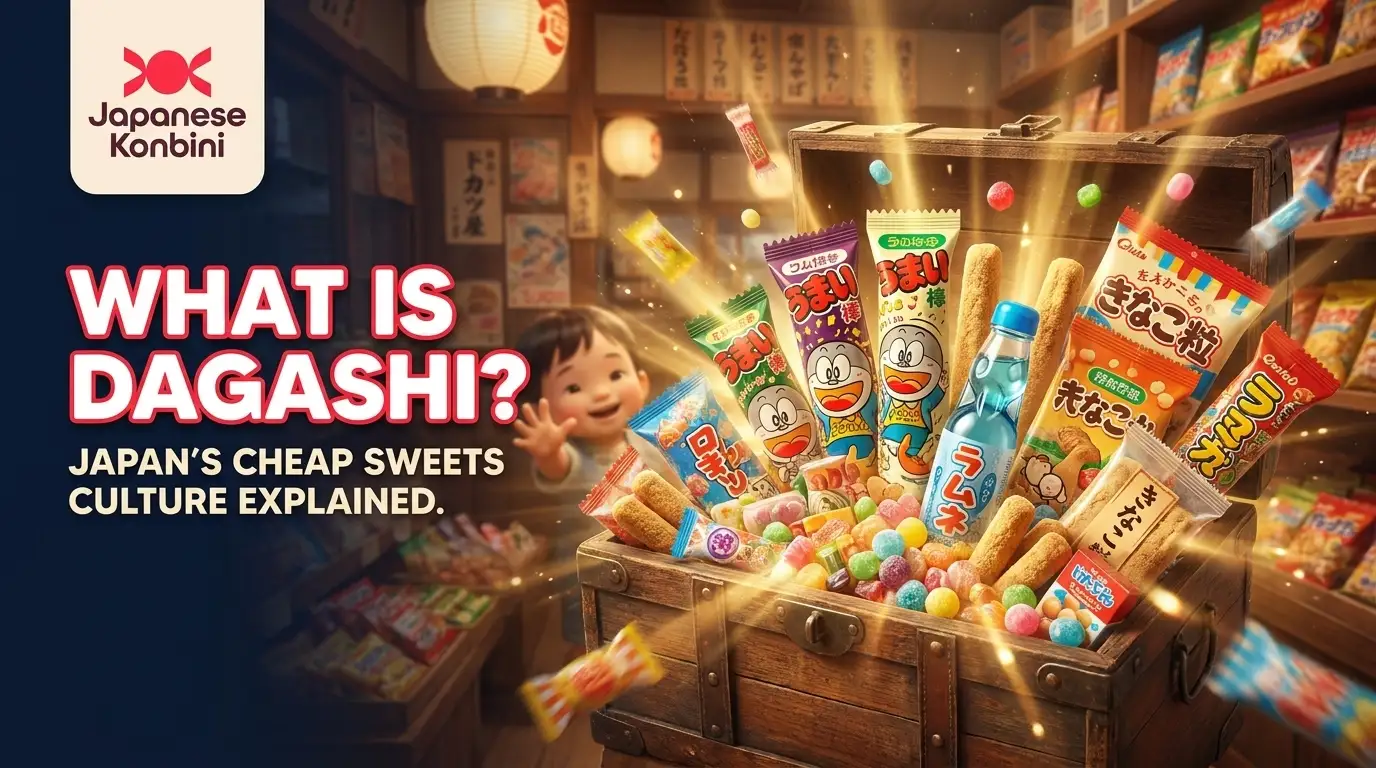
The word dagashi breaks down into two kanji: da (駄), meaning cheap or of poor quality — used here without insult, in the same way you might say "a cheap and cheerful meal" — and kashi (菓子), meaning sweets or confectionery. Dagashi is, literally, cheap sweets. The term encompasses an entire category of small, inexpensive snacks traditionally sold for a few yen apiece, designed to be accessible to every child regardless of their family's income.
In practice, dagashi means corn puffs, rice crackers, sour gummies, fizzy candies, ramune tablets, flavoured sticks, and dozens of other products that sit in that sweet spot between snack and sweet. Most are under 50 yen. Many are under 20. Some, like Umaibo, have held a price point of 10–12 yen for the better part of fifty years.
A brief history
Dagashi culture traces back to Japan's postwar period. As the country rebuilt through the 1950s and 1960s, a particular type of shop emerged in neighbourhoods across Japan: the dagashiya (駄菓子屋), a small, informal sweet shop selling cheap confectionery directly to children. These were not convenience stores — they were something more specific. A neighbourhood institution, often run by an elderly proprietor, where children could spend their pocket money a few yen at a time.
The dagashiya was a social space as much as a retail one. Children would cluster around the counter, deliberating over which sweets to buy with a seriousness of purpose that the economics barely justified. The proprietor would know their regulars by name. Credit was sometimes extended. It was, in its own modest way, a cornerstone of community life.
The dagashiya has largely disappeared from modern Japan, replaced by the konbini and the supermarket. But the products themselves survived, and the nostalgia attached to them runs deep. Ask any Japanese person over thirty about dagashi and you'll get an immediate and specific answer — a particular product, a particular flavour, a particular memory. That's how embedded this category is.
What makes something dagashi?
There's no strict legal definition, but dagashi products tend to share a few characteristics. They're inexpensive and traditionally under 100 yen, often far less. They're small, single-serve portions designed for immediate consumption. They're often playful in their packaging, featuring cartoon characters, games, or interactive elements. And they're made by specialist manufacturers who have focused on this market for decades rather than luxury confectioners who have decided to go mass market.
The major dagashi brands — Yaokin, Ribon, Coris, Marukawa — are largely unknown internationally but are household names in Japan. Yaokin, the maker of Umaibo, has been producing dagashi since 1954 and arguably makes the single most famous dagashi product in history.
Dagashi vs premium Japanese snacks
It's worth drawing the distinction clearly, because both exist in the same konbini and can look superficially similar.
Premium Japanese snacks; KitKats, Pocky, Meiji chocolate bars, Calbee's higher-end crisp lines, are made by large food corporations with significant R&D budgets, sold at prices that reflect their ingredients and branding, and designed to appeal to adults as much as children. They are excellent products. They are not dagashi.
Dagashi is defined by its price point and its cultural position. It doesn't try to be premium. It doesn't need to be. The charm of dagashi is precisely that it costs almost nothing and delivers something genuinely enjoyable, a compact, honest transaction that hasn't changed much since your parents were buying the same things from the same shop.
The two categories coexist without tension. Many Japanese people who buy premium Meiji chocolate for themselves will also buy Umaibo for the same reason they always have: because it's good, it's cheap, and it makes them feel briefly like a child again.
The dagashi worth starting with
If you've never tried dagashi before, Umaibo is the correct entry point. It is the most famous, the most widely available, and the most immediately comprehensible to someone unfamiliar with the category. A hollow puffed corn stick, 11 centimetres long, in more than 20 flavours, for a price that still barely registers on a budget.
We stock four Umaibo flavours: Corn Potage, Cheese, Tonkatsu Sauce, and Mentaiko. If you want the full story on Umaibo specifically — its history, its cultural significance, the 2022 price increase that made national news — we've written about it in detail.
Read: Umaibo Explained: Japan's 10 Yen Snack That Conquered a Nation →
Shop the full Umaibo range →
Why dagashi matters outside Japan
There's a reason dagashi has developed an international following in recent years, driven partly by food tourism and partly by the anime Dagashi Kashi, which ran from 2016 and introduced the category to a global audience who had previously never considered it.
The appeal is not complicated. Dagashi is fun. It is low-stakes. It rewards curiosity without punishing your wallet. In a market increasingly dominated by premium, artisanal, and "experiential" food products, there is something quietly radical about a snack that costs pennies, does exactly what it says, and has been doing it for fifty years without feeling the need to rebrand.
It is also, genuinely, delicious. The fact that something is cheap does not make it lesser. Yaokin has had seven decades to perfect Umaibo. They have used them well.
Browse our full range of authentic Japanese snacks — dagashi and beyond — shipped directly from Tokyo.